Evaluating the free market by comparing it to the alternatives (We don't need more regulations, We don't need more price controls, No Socialism in the courtroom, Hey, White House, leave us all alone)
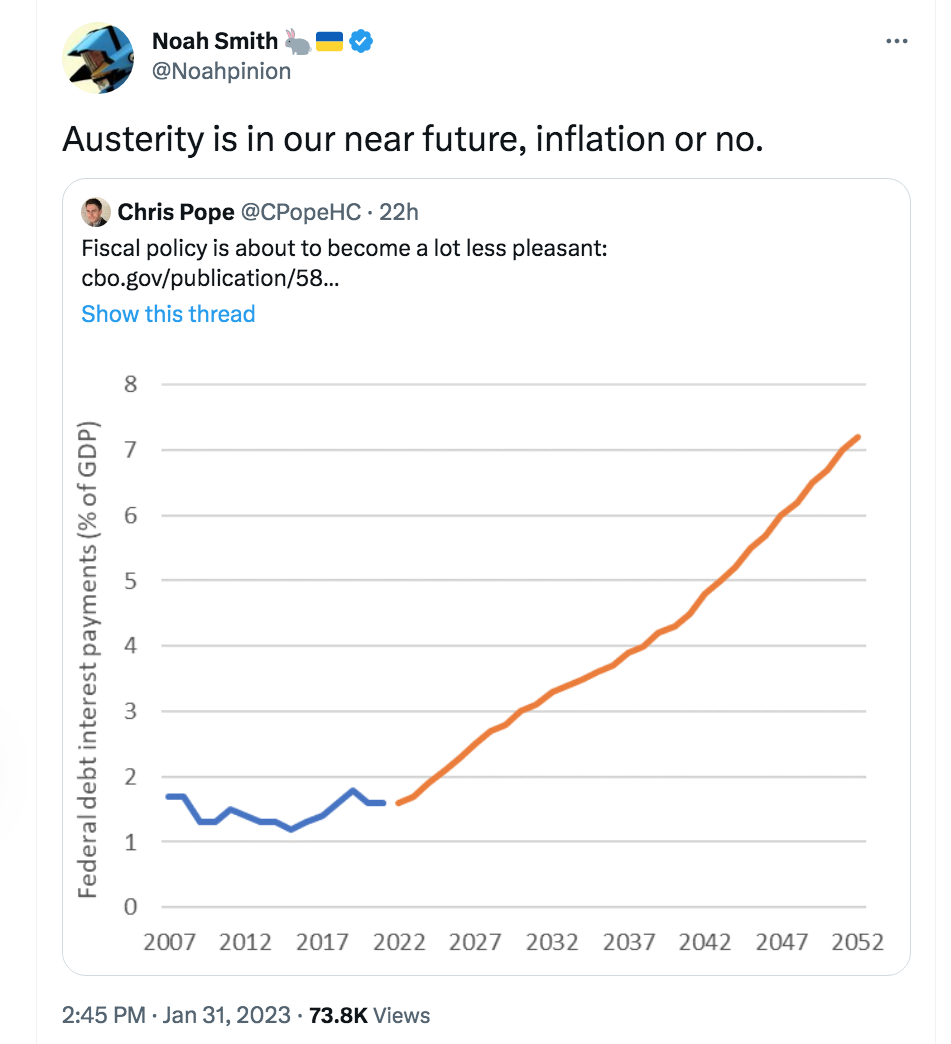
"For years I’ve been
warning that reckless fiscal policy (under Trump and Biden) would lead
to future tax increases. And for years I’ve been attacked as an old
fogey who doesn’t understand that we are in a new era of zero interest
rates, a new era of free credit forever.
Monetary policy is
about aggregate demand. Fiscal policy is about efficiency. The
profession made a huge mistake in conflating the two policies.
PS. There are a few signs the economy might actually be speeding up:
Vacancies at US
employers unexpectedly increased at the end of 2022, illustrating a
solid appetite for labor that the Federal Reserve sees as one of the
last hurdles to bring down inflation.
The number of
available positions climbed to a five-month high of just over 11 million
in December from 10.4 million a month earlier, the Labor Department’s
Job Openings and Labor Turnover Survey, or JOLTS, showed Wednesday. The
increase was the largest since July 2021 and mostly reflected a jump in
vacancies in accommodation and food services.
(While I’m doing my
annoying “I told you so” routine, I might as well add that I ridiculed
those who claimed two falling quarters of GDP meant we were in recession
during early 2022. I don’t recall any previous recessions with record
job openings.)
Tyler Cowen has a post discussing the possibility of the economy reheating, and has this to say:
Another possible
pathway for these scenarios involves interest rates. During a normal
disinflation, the Federal Reserve raises rates and keeps them high for a
long period of time while the economy adjusts slowly — often passing
through recession. But inflation has fallen more rapidly than expected,
and so the market may expect the Fed to lower interest rates sooner than
planned. And an expected cut in interest rates can encourage
expansionary pressures just as much as an actual cut in interest rates.
It is a funny world
in which slow inflation can cause faster inflation. It’s the logic of
expectations that makes it possible, albeit far from certain.
Of course this would not be a case where low inflation is directly
causing high inflation. Rather, if this happened it would be a case of
the Fed looking at inflation when it should be looking at NGDP growth,
and wrongly concluding that monetary restraint is no longer needed.
Persistently excessive inflation is always and everywhere a monetary
policy failure."
No comments:
Post a Comment
Note: Only a member of this blog may post a comment.

No comments:
Post a Comment
Note: Only a member of this blog may post a comment.