Evaluating the free market by comparing it to the alternatives (We don't need more regulations, We don't need more price controls, No Socialism in the courtroom, Hey, White House, leave us all alone)
Friday, June 5, 2020
Unemployment Far Worse in Lockdown States, Data Show
By Abigail Devereaux. She is a professor of economics at Wichita State University.
"The novel coronavirus has done severe economic damage all over the
globe. The Congressional Budget Office (CBO) stated on June 1, 2020 that
it could take nearly a decade for the economy to grow back to levels forecasted this January.
As economists, we want to understand just how much damage has been done
to what people and sectors and how that damage was perpetrated. There’s
usually more than one perp in a Depression.
First, the coronavirus obviously causes direct health effects that
can impact economies. Note that economists like myself are not
suggesting illness or death is bad primarily because of their economic
effects; the social and personal costs of pandemics are devastating on
their own. Second, people voluntarily change their consumption,
work, and personal behavior in reaction to pandemics, without the need
for any intervention. Third, political interventions like stay-at-home
orders and business closures coercively change consumption, work and
personal behaviors in ways that impact economies.
In this study, I’m interested mostly in the effects of political
interventions. No one person can do much to affect mass, decentralized
behavioral changes. But political officials taking advice from
epidemiological and economic experts can directly and severely affect
state and regional economies.
The numbers I use to track these intervention-based effects are
state-specific insured unemployment claims from March 1, 2020 until May
9, 2020, the most recent reflected week at the time of writing. I group
states by their lockdown status circa the most recent reflected week.
Generally, I index insured unemployment rates to 0% on March 1, 2020, so
what you’re seeing in these charts is the difference between the
unemployment rates in each state reflecting the two weeks ending on
March 1, 2020 and the unemployment rates in each state reflecting the
two weeks ending on May 9, 2020.
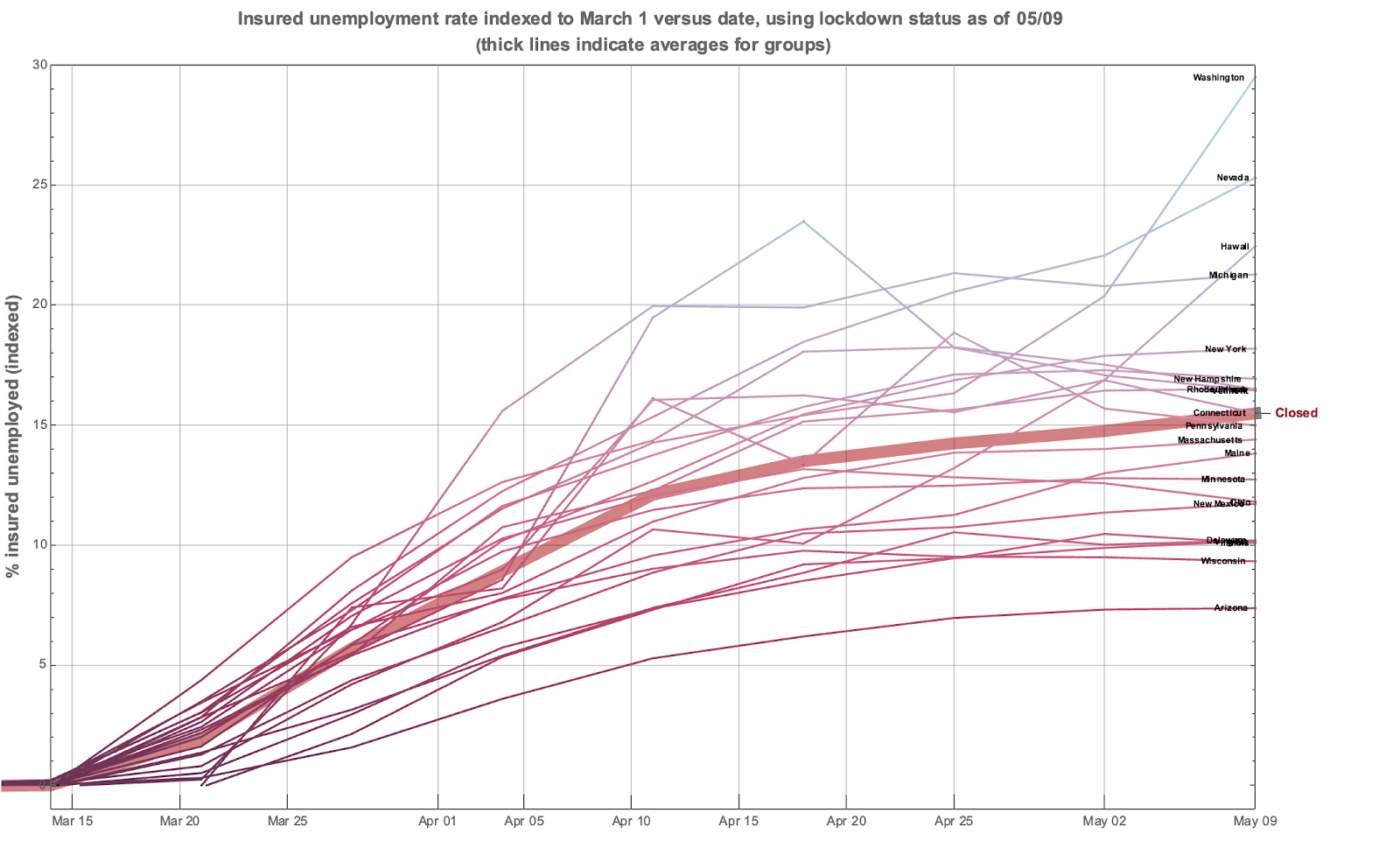
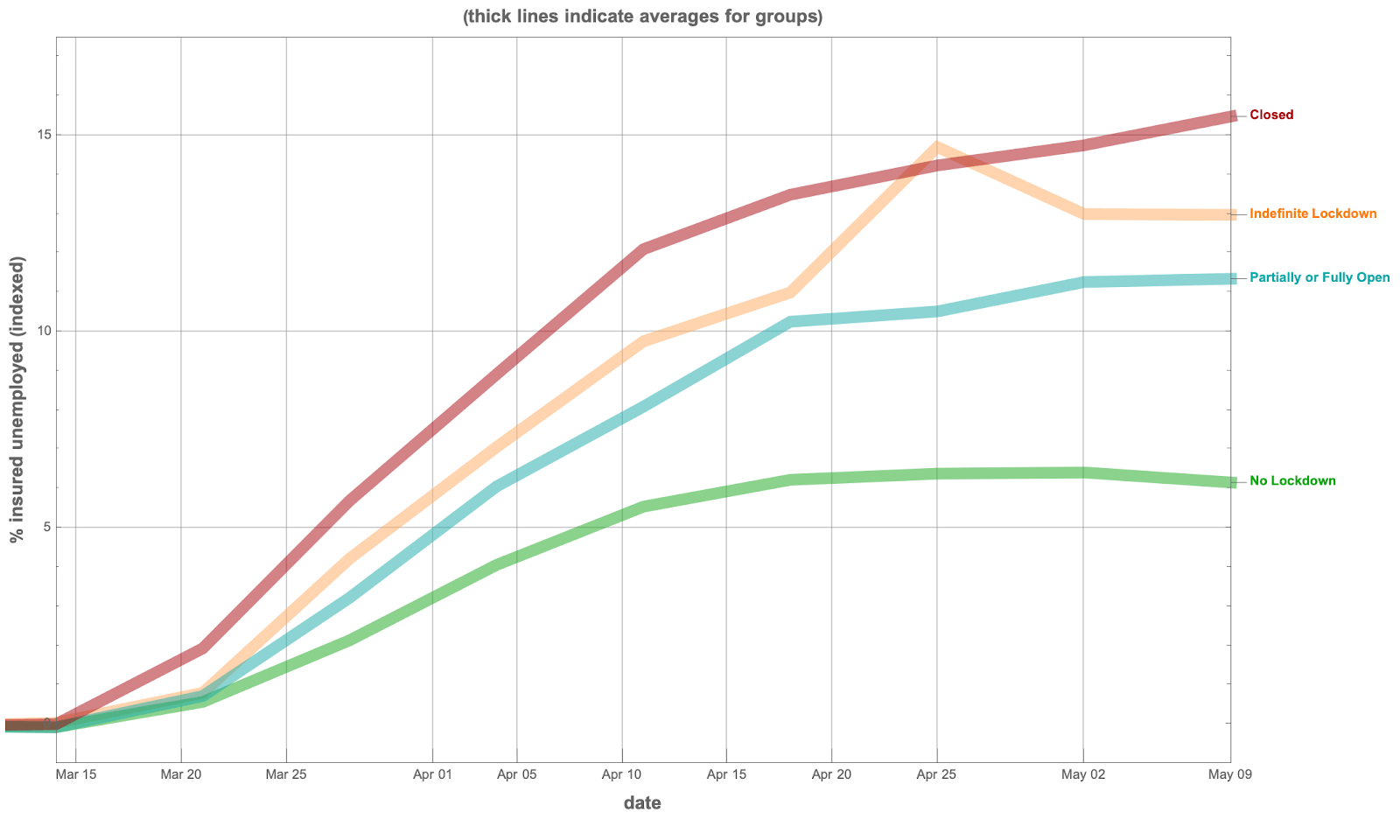
First, let’s look at the series for all states from March 15, 2020
(rates are extremely stable before that) and May 9, 2020. Each thin line
is a state’s own series, colored by group. States locked down but with
stated lockdown end dates are red, states locked down with no stated end
dates are orange, states partially or fully reopened are blue, and
states with no official lockdown are green. Thick lines in the series
represent group averages.
Next, let’s take a look at each group. I start with states that were
still locked down on May 9, since their group average (15.5% insured
unemployed) is the highest of all the groups.
Washington (29.5% indexed to March 1 and 31.2% unindexed
unemployment), Nevada (25.3% indexed to March 1 and 26.75% unindexed
unemployment), and Hawaii (22.45% indexed to March 1 and 23.42%
unindexed unemployment) have the highest levels of unemployment in the
closed group.
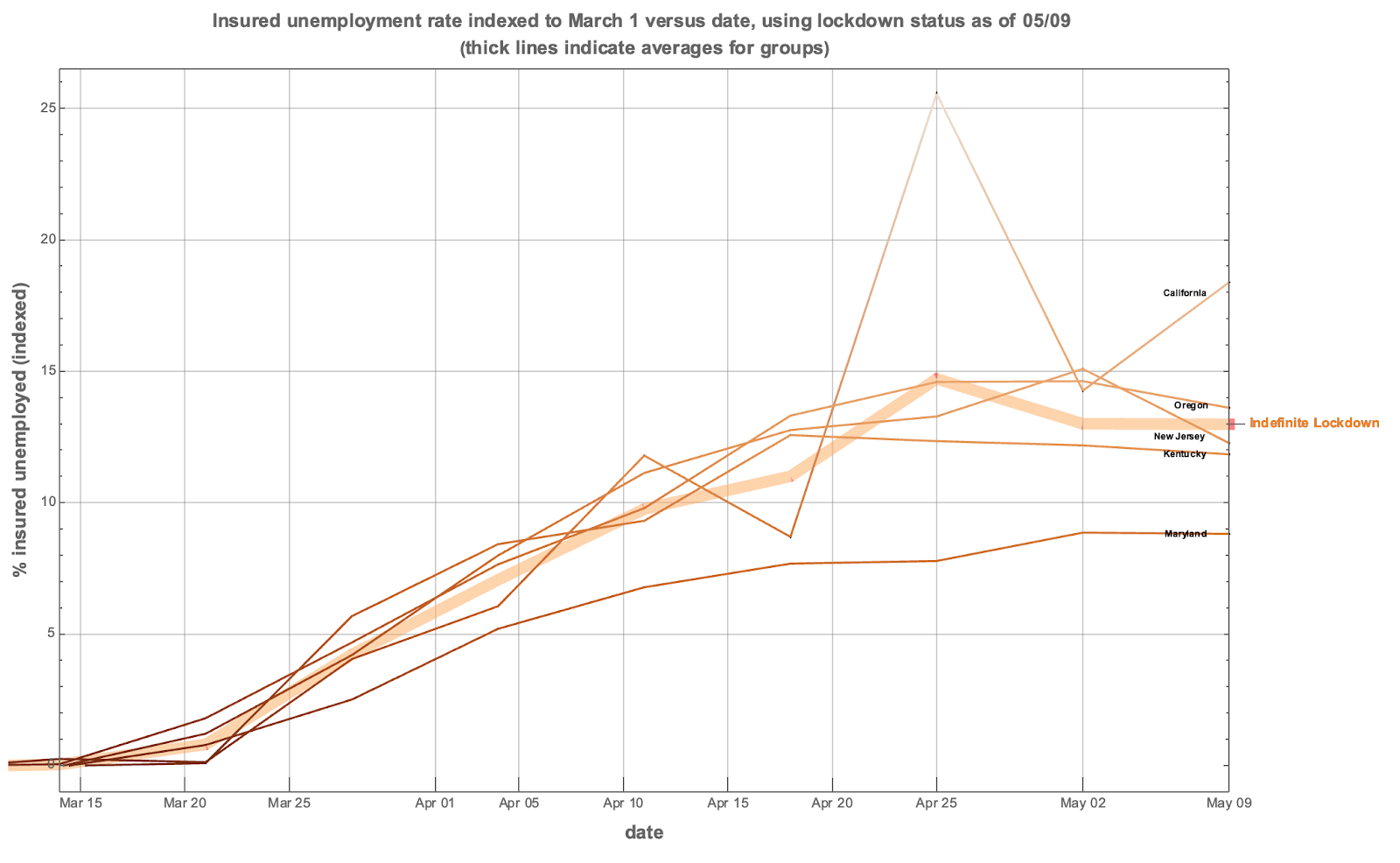
In the next graph, I look at the states locked down on May 9 whose lockdowns didn’t have definitive end dates.
There aren’t many states in this group as of May 9. It’s important to
note that some states started their lockdowns in March and April with
indefinite lockdowns and by May 9 had formulated plans with on-paper end
dates or phased reopenings.
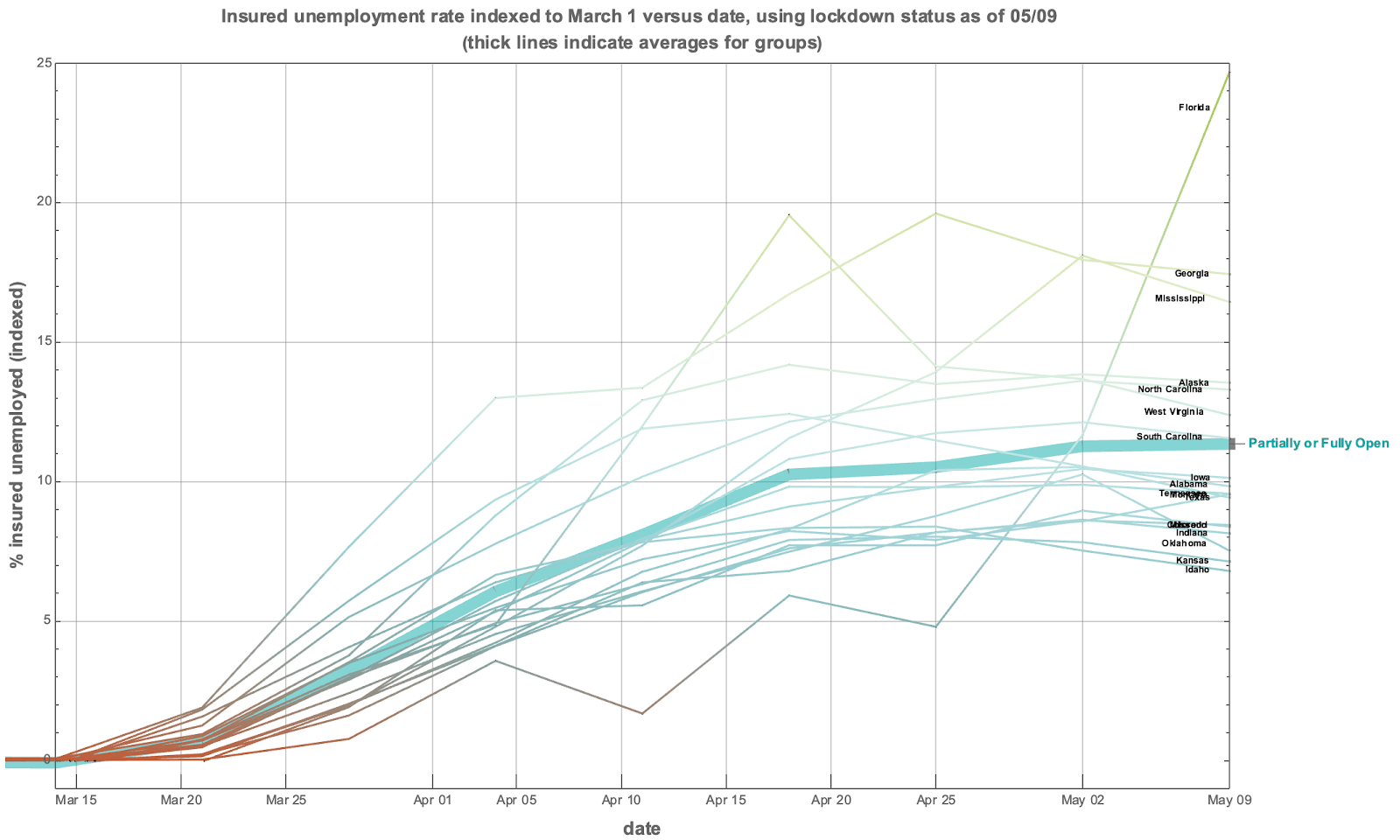
The next graph looks at states amidst a partial or full reopening as
of May 9. Note that this group consists of both states whose reopenings
were weeks old and states whose reopenings were brand new as of May 9.
For the sake of rigor I disincluded states that reopened on May 9, and kept those states in the “closed” group.
Florida is the obvious outlier of this graph, with 29.5% indexed to March 1 and 31.2% unindexed unemployment.
The final graph looks at the states with no formal shutdown orders, or what I call “no lockdown” states.
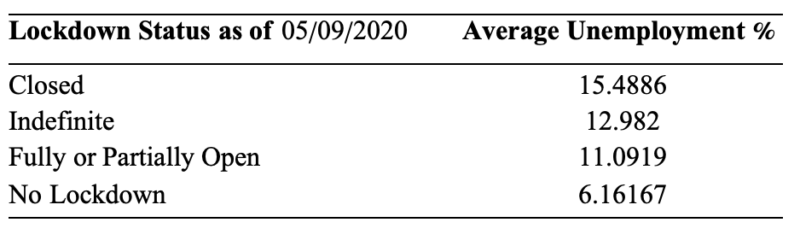
What story do these graphs tell? An incomplete story, to be sure,
like watching a very small part of a crime scene in which there are
several perpetrators unfold before one’s eyes. Here’s a summary table of
where group averages were on May 9:
In general, states that were still closed on May 9 had the highest
average insured unemployment rates relative to the average for that same
group on March 1. The unemployment rate of fully locked down states was
at least double than states that had no formal lockdown. States that
were fully or partially opened by May 9 fared better than fully locked
down states, but as a group had almost double the average insured
unemployment rate of states without a formal lockdown.
It’s important to issue a few caveats upon further study of this unfolding scene.
First: many states are still today (the beginning of June 2020) in
the middle of reopening. Some states like Washington and Wisconsin have
seen challenges (in the case of Wisconsin, successful) to their ongoing lockdown.
Second: there is no direct tradeoff between economic health
and population-level health. It isn’t clear to what extent lockdowns
will reduce COVID-19 fatalities and infections in the long run, as the
imposition of general quarantines naturally slow the rate at which a
population reaches herd immunity given that they are designed to slow the spread of the virus.
If general quarantines damage the economy enough to send it into its
worst depression since the Great One our grandparents lived through, but
do not significantly reduce fatalities and infections in the long run,
get us foreseeably closer to a workable vaccine, or protect the most
vulnerable in particular, then lockdowns might maximize economic pain
for minimal health gains.
This is what the unemployment data seem to say at the moment.
Economists should continue to look at this and other numbers for clues
that can help us understand how best to put together the story of this
unfolding scene, so that if some kinds of interventions turn out to be
perpetrators instead of panaceas, we know to advise against employing them in the future."


No comments:
Post a Comment
Note: Only a member of this blog may post a comment.