Tuesday, December 16, 2025

What’s the Matter With Scotland?

Novelist Allan Massie ponders how the birthplace of Adam Smith and Walter Scott declined into a depressing culture of dependence, passivity and stagnation.

By Barton Swaim. Excerpts:

"Scottish voters in the late 20th century, though culturally conservative, mostly despised Margaret Thatcher and found heavy-handed economic and social policies far more attractive than their English counterparts did. Why? “The Scottish economy at the end of the 19th century was a powerhouse, but it rested on industries that went elsewhere—shipbuilding, heavy machinery, iron and steel and so on.”

These industries largely collapsed after World War I, re-emerged during the next world war, then died again—leaving mass unemployment and a widespread suspicion of capitalism and deregulation. “From the 1960s or 1970s on, the only thought was of the collective” in Scotland. “Only the state could turn things around, only communal action,” Mr. Massie says. “Thatcher was all about individualism. Scotland was—this was the thinking—about the collective, the state.”

The consequence, decades later, was a culture marked by dependency. “A much greater proportion of people in Scotland in the 1970s lived in public housing—schemes they’re called—than elsewhere in . . . the free countries of Europe.” A lot of state intervention was understandable, given the economic realities, Mr. Massie judges, but “it did much to harm the Protestant work ethic that had once been so important in Scotland.”"

"there isn’t a single serious intellectual magazine or book review published in Scotland. An amazing fact, inasmuch as Scotland produced the first important book review: the Edinburgh Review, founded in 1802."

"modern European proponents of welfare-state liberalism likened to a dying class of 19th-century hereditary nobles, confident in their rightness and desperate to rest. The socialist outlook—I use the word in the broadest sense—may inspire struggle in the immediate present, but the practical goal is tranquility, perpetual rest in an equality of outcomes: an attitude not so different from that of a predemocratic, precapitalist European noble hoping to keep his subjects more or less content with little gifts from his largess."

"“Things are not getting better, they’re getting worse.”" 

Monday, December 15, 2025

China’s Manufacturing Is Booming Despite Trump’s Tariffs

U.S. pressure has only cemented its rival’s status as the world’s indispensable factory floor, sending its trade surplus above $1 trillion

By Jason Douglas and Jon Emont of The WSJ. Excerpts:

"Chinese industrial production broke records this year as its factories churned out more cars, machinery and chemicals than ever before. Despite the disruptions of tariffs, the country’s trade surplus in goods has set a record, as growing shipments to Asia, Europe, Latin America and Africa offset the hit from Trump’s levies on direct sales to the U.S.

Chinese companies that built their business around low trade barriers to sell into the U.S. have adapted and in some cases are bouncing back."

"China reported a goods trade surplus of more than $1 trillion for the year through November, while manufacturing output in the first 10 months of the year was up 7% compared with the same period in 2024."

"The economy is battling an insidious phenomenon dubbed “involution,” in which cutthroat competition and ballooning industrial capacity are pushing down prices, profits and incomes."

"U.S. efforts to contain China’s economic and strategic ambitions and weaken its grip on essential global supply chains are falling flat. They might even be counterproductive, analysts and economists say, as Chinese policymakers conclude they need to dominate more industries to shield their economy from U.S. pressure and give them more chokepoints they can exploit"

"direct exports to the U.S. did take a hit from tariffs, falling about 19% over the same period. But the decline was more than made up for by sales to other regions, with exports to Southeast Asia up 14%, exports to the European Union up 8%, exports to Latin America up 7% and exports to Africa jumping by more than a quarter."

"Some of those exports probably found their way to the U.S."

"Average tariffs on Chinese imports are currently around 37%, according to the Tax Policy Center, compared with a rate of about 20% on Vietnamese imports"

"Chinese leader Xi Jinping is instead doubling down on a factory-powered future. A new five-year plan’s biggest priorities are supporting cutting-edge manufacturing" 

Drugmakers Are Ditching Middlemen to Sell Directly to Patients

Companies are rolling out direct-to-patient services, which are selling drugs for weight loss and other uses

By Peter Loftus of The WSJ

Patients are saving money as a result of voluntary actions by these firms. Excerpt: 

"Drugmakers are moving to sell their medicines directly to patients, abandoning the middlemen they have long relied on.

The shift is a huge departure from how pharmaceutical companies including Eli Lilly, Novo Nordisk and Pfizer have sold drugs for decades and threatens the multibillion-dollar business of firms that have traditionally filled prescriptions. 

It is saving some patients hundreds of dollars off the cost of prescriptions because companies have been lowering the prices for drugs sold directly."  

A Divided Fed Cuts Rates Again—but Why?

The central bank predicts faster economic growth in 2026 but still eases again

WSJ editorial. Excerpts:

"When the rate cuts began more than a year ago, officials predicted they’d get inflation back to the Fed’s 2% target by 2026. That deadline keeps getting pushed back, and in the Summary of Economic Projections released with Wednesday’s policy decisions, the 2% arrival date is now 2028."

"Mr. Powell says this isn’t quantitative easing to achieve lower interest rates or economic growth. They believe they need to expand their asset holdings to match the level of reserve deposits commercial banks are likely to want to hold. But it’s a reminder that the Fed’s post-2008 “ample reserves” policy framework probably will require the Fed to be a net purchaser of Treasurys forever. Remember when this extraordinary Fed intervention in financial markets was going to be temporary?"

A Climate Study Retraction for the Ages

A much-hyped study in the journal Nature turns out to have been full of errors

WSJ editorial. Excerpts:

"The study . . . projected that climate change could cause $38 trillion in economic damage a year by 2049. To put that number in perspective, the GDP of North America last year was about $31.4 trillion."

"forecast that rising CO2 emissions would cause a 62% reduction in global GDP by 2100"

"scientists flagged problems with its methodology and errors in its data. In July 2024, Nature issued a correction noting that rows of data were “wrongly printed as a decimal, rather than a percentage point.”"

"Other scientists [said] the study “underestimates uncertainty . . . rendering their results statistically insignificant when properly corrected.”"

"“data anomalies arising from one country” in the “underlying GDP dataset, Uzbekistan, substantially bias their predicted impacts of climate change.” 

"the economic harm from climate change no longer exceeded the costs of the government interventions" 

Sunday, December 14, 2025

World Trade Grows Without the U.S.

Other nations are busy expanding commercial ties, as the U.S. economy is increasingly isolated

By Phil Gramm and Donald J. Boudreaux. Excerpts:

"After President Herbert Hoover signed the Smoot-Hawley Tariff Act in 1930, 25 countries imposed retaliatory tariffs"

"the real value of world trade plummeted by more than 65% between 1929 and 1933."

"fear that under the gold standard, countries hit by U.S. tariffs would have to settle their trade deficits in gold, depleting their gold reserves and money supply"

"Governments no longer have to worry about trade deficits causing deflation."

"Our 10 largest trading partners on average export and import 55.5% more of their gross domestic product than the U.S. does."

"Canada has responded to U.S. tariffs by launching a trade expansion effort, including a meeting between Mr. Carney and Xi Jinping"

"Dramatic improvements in transportation and communications have made it much easier for exporters and importers to find alternative markets"

"The rise of small-volume carriers such as FedEx, UPS and DHL along with the significant fall in freight rates have made trade diversion and diversification easier and more profitable. As important, the cost of instant international communication and search has fallen to near zero."

"Chinese exports to the U.S. fell by 69% from February through September, but Chinese exports to other regions rose."

"China will close out 2025 having exported 8.3% more than last year"

"U.S. exports, by contrast, are projected to fall next year by 3.4%."

"Before tariffs, well over half of U.S. imports were inputs used by American producers." 

"Obliged by Mr. Trump’s protectionism to produce goods we could buy cheaper abroad and shielded from the competition that drives peak performance, U.S. producers will become less efficient and less competitive on the world market." 

FDR’s Faulty Economics

Americans are as capable of shopping on a Nov. 23 that falls before Thanksgiving as on a Nov. 23 that falls after

Letter to The WSJ

"Allen Torrey claims that if Thanksgiving were allowed to fall on the last Thursday of November instead of the now-established fourth Thursday, the result in years with five Thursdays would be to “curtail the Christmas shopping season and harm the national economy” (Letters, Dec. 2).

Not so. Americans are as capable of shopping on a Nov. 23 that falls before Thanksgiving as on a Nov. 23 that falls after. Why? Because the amount of money we spend on Christmas gifts is determined by our incomes, our consumer confidence and the price of goods. The number of calendar days between the two holidays is economically irrelevant.

Even if fewer days caused us to spend less on presents, that foregone money would either go toward other consumer purchases or be kept in savings that fund investments. There’s no reason to suppose that “aggregate demand” is affected by how much Americans spend on Christmas gifts—and, hence, no reason to suppose the economy would be harmed if holiday spending fell.

Veronique de Rugy

Arlington, Va.

Saturday, December 13, 2025

Scott Sumner on The Great Depression.

See The Great Depression: Elevator pitch. Excerpts:

"Between 1929 and early 1933, NGDP in the US fell by roughly 50%. So why didn’t all wages and prices also fall by 50%, leaving output and employment unchanged?" 

"The answer is “sticky wages and prices”, which is the key assumption in business cycle theory." 

"when smaller and more unpredictable changes in the purchasing power of money occur, wages and prices are slow to reflect this reality. The economy moves into “disequilibrium”, with either labor shortages (as in 2022), or huge labor surpluses (as in 1933.) A surplus of labor is called unemployment. When NGDP fell in half during the early 1930s, wages and prices did move somewhat lower, but the adjustment was far too small to prevent a major fall in output and employment."

"You can say that the Great Depression was “caused” by sticky wages and prices, but to me that’s like saying an airplane crash was caused by gravity. Sticky wages and prices are a given, what we need is a monetary policy that stabilizes total nominal spending and income, i.e., a stable path of NGDP. We didn’t have that policy in the early 1930s, and this policy failure resulted in the Great Depression."

"In the early 1930s, there were two media of account, US currency notes and gold. There was a fixed exchange rate between them at $1 = 1/20.67 ounces of gold (which is smaller than a dime)."

In 1929, changes in US nominal variables could be modeled in one of two ways, changes in the value of US currency or changes in the value of gold. I found the gold modeling approach to be more useful, as it was a global gold standard and a global depression, so the best explanation needs to look beyond what was happening in the US. For example, the Canadian currency stock fell sharply during the early 1930s. But it’s not useful to think in terms of Canadian monetary policy causing the Canadian Great Depression. Their dollar was also tied to gold, and Canada was an innocent bystander, dragged into depression by monetary disturbances in bigger countries like the US and France, which boosted the global purchasing power of gold.

The US price level fell by roughly 25% during the early 1930s (depending how you measure it.) That means the two media of account (currency and gold) gained much more purchasing power. One ounce of gold could buy a lot more stuff in 1933 than in 1929, as the purchasing power of money is inversely proportional to the price of goods and services. But wages and prices did not fall anywhere near as much as the 50% decline in NGDP and as a result, real output and employment also fell sharply.

In a sense, the economic slump of 1929-33 was caused by a nominal shock—a sharp increase in the value of currency and gold, which depressed spending and output. To explain what “caused” the Great Depression, therefore, we need to explain what caused this nominal shock. Why did the purchasing power of gold rise so sharply during the early 1930s?

Supply and demand is our workhorse model for explaining changes in the value of any good, service, or asset, and gold is no different. Each year, the global supply of gold (the total stock of existing gold) gets a little bit bigger due to the output from gold mines, combined with the fact that very little gold is lost. Gold supply was not the problem.

If there was no decline in the total stock of gold, then any big increase in its value had to be due to an increase in gold demand. (The same is true of Bitcoin.) I argued that the Great Depression was caused by a big increase in gold demand between 1929 and 1933. But it doesn’t take 500 pages to make that simple point. Therefore, I also analyzed the various factors that led to increased gold demand. 

During the early 1930s, major central banks held huge reserves of gold, indeed they held most of the gold that had been mined since the beginning of human history. This gold was held as “reserves”, backing up paper money. People could take a $20 bill to the US government and redeem it for roughly an ounce of gold. A typical government might hold a 40% gold reserve ratio—$4 million worth of gold backing up each $10 million in currency. But the gold reserve ratio was not constant. So why did global gold demand rise so sharply during the early 1930s? Three reasons:

  1. Individuals and banks were hoarding currency due to fear of bank failures, and more gold was needed in reserve to back up this extra currency demand.

  2. Central banks also hoarded gold, by increasing their gold reserve ratios. They became “cautious”, which individually might make sense but at the global level was counterproductive.

  3. Individuals hoarded gold in fear of currency devaluation, especially after countries such as Britain and German left the gold standard in 1931.

The decision of people, banks, and governments to hoard gold was often prudent at an individual level, but socially destructive. The first year of the Depression is the easiest to explain, as it was almost entirely caused by central bank gold hoarding—a higher gold reserve ratio—especially in the US, France and the UK. In each case the motivation for hoarding was complex and it differed from one country to another. After late 1930, bank failures increased and people began hoarding more currency. After mid-1931, private gold hoarding began increasing due to devaluation fears.

In the early 1930s, there was an almost perfect storm of bad luck and bad decision-making, which is why “Great Depressions” are so rare. When you look at other theories of the Great Depression, they generally imply that huge depressions should happen quite often, but they don’t. Thus the 1987 stock market crash was almost identical in size to the late 1929 stock crash but had no measurable impact on the broader economy. The stock crash didn’t cause the depression.

In late 1937, there was a smaller (but still sizable) secondary depression, partly caused by a renewed bout of gold hoarding. You can think of 1929-33 and 1937-38 as the two parts of the Depression that were caused by adverse nominal shocks. Gold hoarding increased for a variety of complex reasons, and this led to lower NGDP and a lower price level. Because nominal wages are slow to adjust, falling NGDP generally leads to much higher unemployment and lower real output, at least in the short run.

Part 3: Counterproductive wage policies

Both President Hoover and President Roosevelt misdiagnosed the Depression. But Roosevelt’s policies were more successful. That’s because while both had counterproductive labor market policies, Roosevelt had an expansionary monetary (gold) policy.

Although wages were “sticky” (slow to adjust) during pre-WWII depressions, workers eventually would accept wage cuts. After 1929, however, Hoover pressured large corporations to refrain from their usual nominal wage cuts, and thus wages were even stickier than during the previous depression of 1920-21. Hoover probably thought that stable wages would help to maintain aggregate demand (NGDP), but in fact the policy reduced aggregate supply, as companies laid off workers when prices fell below the cost of production.

After taking office in March 1933, Roosevelt gradually devalued the dollar, from 1/20.67 ounces of gold to 1/35 ounces in early 1934. To use the analogy at the beginning of this post, this is like making the measuring stick smaller, in order to make all objects you measure appear larger. Normally, that would be pointless, as nothing changes in real terms. But when wages and prices are sticky, a less valuable dollar leads to more output and employment.

By March 1933, industrial production had fallen to roughly one half of its pre-depression level. Just 4 months later, industrial production had risen by 57%, regaining over half of the ground lost during the previous 4 years. That brief boomlet was mostly due to dollar depreciation. If that had been Roosevelt’s only policy, the Depression likely would have ended within a couple more years. Instead, Roosevelt took other (counterproductive) actions, and the Depression dragged on until 1941.

Like Hoover, Roosevelt believed that higher wages would boost aggregate demand. He was confusing cause and effect. Yes, wages often decline somewhat in a deep slump. But that’s an effect of the depression, not the cause. Rich people often have Rolls Royces. But buying a Rolls Royce makes you poorer.

In mid-July 1933, Roosevelt issued a proclamation that essentially forced employers to raise nominal wages by 20% almost overnight. The explosive economic recovery immediately ground to a halt, and by the time the Supreme Court declared this policy unconstitutional in May 1935, industrial production was actually lower than in July 1933. But the Supreme Court was doing Roosevelt a favor, as industrial production immediately began rising rapidly after the Orwellian named National Industrial Recovery Act was rejected by the Court. (Will our Supreme Court do Trump a similar favor on tariffs?)

In my book, I discussed no less than five different wage shocks imposed by the Roosevelt administration, each of which led to a pause in the recovery."

"What are the policy lessons?

"During and after the Depression, the gold standard was gradually weakened, before being phased out entirely in March 1968. Today, we no longer need to worry about gold hoarding causing a depression. When there is currency hoarding, the central bank can now meet the extra demand by supplying additional fiat currency. And US government no longer uses wage policies in the aggressive fashion employed by Hoover and Roosevelt. Yes, we technically have a $7.25 federal minimum wage, but it’s largely meaningless. In many states, wages are now set by the market.

Monetary policy continues to be more erratic than I would like. It was much too contractionary in 2008-09 and much too expansionary in 2021-22. Even so, it has become more stable than earlier in US history. That’s why we haven’t seen a repeat of the Great Depression."

Here is what Timothy Cogley said in 1999 when he was at the Federal Reserve Bank of San Francisco (1999). He is now at New York University:

"First, stock prices were not obviously overvalued at the end of 1927. Second, starting in 1928 the Fed shifted toward increasingly tight monetary policy, motivated in large part by a concern about speculation in the stock market. Third, tight monetary policy probably did contribute to a fall in share prices in 1929. And fourth, the depth of the contraction in economic activity probably had less to do with the magnitude of the crash and more to do with the fact that the Fed continued a tight money policy after the crash. Hence, rather than illustrating the dangers of standing on the sidelines, the events of 1928-1930 actually provide a case study of the risks associated with a deliberate attempt to puncture a speculative bubble."

See Monetary Policy and the Great Crash of 1929: A Bursting Bubble or Collapsing Fundamentals? 

Friday, December 12, 2025

A year end blessing: No net neutrality

By Brian A. Rankin of CEI.

"As we approach the end of the year, it’s a natural time to reflect on what we’re grateful for. While many blessings come to mind, one worth highlighting is something we don’t have: net neutrality.

After all the years of arguments, FCC orders, and appeals, one might recoil from the mere mention of the topic. We may not look back on the net neutrality saga fondly, but it is worth recognizing what the Sixth Circuit Court of Appeals’s reversal of the Biden FCC’s net neutrality order makes possible today.

Rather than heavy-handed utility-style net neutrality regulation, the United States has a light-touch broadband regulatory regime – one that emphasizes investment, innovation, and flexible network management. The results are measurable. According to the USTelecom 2025 Broadband Pricing Index, real broadband prices have continued to fall while speeds have continued to climb.

From 2024 to 2025, the price of providers’ most popular service tiers (100 Mbps to 940 Mbps) fell by 8.7 percent, and since 2015, inflation-adjusted prices for those plans have dropped 63.4 percent. Meanwhile, download speeds have doubled, and upload speeds have increased by more than 80 percent. Consumers are getting far more value for every broadband dollar they spend.

The evidence leads to a clear conclusion: light-touch regulation is working. Americans continue to access any lawful website or video service they choose, and they benefit from a wide range of broadband plans and providers. None of the dire predictions made during the net neutrality debates – slowed traffic, blocked websites, or ISP-driven censorship – came to pass.

We should appreciate a regulatory environment that recognizes the importance of continued network investment, innovation, and competition. The strong performance of US broadband under a light-touch framework is a reminder that sometimes what we avoid is as important as what we achieve." 

Austin and Atlanta have pulled off something rare: rent declines. Their rapid construction and intentional growth offer a model for the rest of the country. 

By Patrick Carroll of AIER. Excerpts:

"In a September article, Realtor.com highlighted three metros that are seeing the biggest declines. 

“Rents in Las Vegas (-13.6 percent), Atlanta (-13.6 percent), and Austin, TX (-13.4 percent), are seeing the largest price cuts from their peaks, highlighting prime opportunities in these markets,” writes Joy Dumandan."

"Economist Jiayi Xu offered an explanation for these trends. 

“Las Vegas, Austin, and Atlanta saw the largest rent declines from their peaks due to rapid rent growth during the pandemic, when many people moved to warm Sun Belt areas, creating a high starting point for corrections,” she said. “Migration trends have slowed, and significant new multifamily supply has increased options for renters, exerting downward pressure on prices,” she continued. “Combined, these factors have pushed rents down more sharply than in other markets.”

Xu’s comment about “significant new multifamily supply” is key."

"Markets with the biggest rent deflation over the last 3 years: 

Austin: -21% 
Fort Myers: -19% 
CoSprings: -15% 
Phoenix: -14% 
Raleigh: -13% 
San Antonio: -12% 
Atlanta: -11% 
Denver: -11%" 

"An August report from RentCafe looked at new apartment construction in 2025 across the US and identified the places that are building the most units. The South overall had a strong showing, accounting for 52.5 percent of the 506,353 units that are expected to be opened nationwide by the end of the year. Within the South, Texas is experiencing some of the biggest housing growth, fueled especially by growth in Austin.

The report presented a ranking of the US cities that are building the most housing this year, as well as a separate ranking for US metros. Austin took the top spot in the country on the city level, with an estimated 15,195 units expected to be completed this year. Austin came third in the country on the metro level with 26,715 units expected to be built, behind Dallas (28,958) and New York City (30,023)."

"Atlanta came sixth in the country on RentCafe’s list of cities, with 6,359 new units expected to be completed this year. The Atlanta metro area took fifth place on the metros list, with 17,512 units expected."

"How can we add more supply? One of the best ways is deregulation. As economist Bryan Caplan explains in his recent illustrated book Build, Baby, Build, the main reason housing is so expensive is because of manufactured scarcity — restrictions on the supply of housing created by government regulations. 

“Housing prices stay high in desirable areas,” Caplan writes, “because most governments strictly regulate new construction.”

Caplan anticipates a common reaction: “Sounds more like Right Wing Ideology 101 to me.” This is understandable, but Caplan stresses that housing deregulation is a bipartisan issue that even non-right-wingers should be able to champion. He points to progressive thinkers like Paul Krugman, Obama-advisor Jason Furman, and Matt Yglesias as people whose left-wing credentials are not in doubt, yet who acknowledge that strict regulation really is a big part of America’s housing problem."

Thursday, December 11, 2025

Mass Incarceration and Mass Crime

By Alex Tabarrok.

"In our Marginal Revolution Podcast on Crime in the 1970s, I pointed out that blacks were often strongly in favor of tough on crime laws:

Tabarrok:  [P]eople think that mass incarceration is a peculiarly American phenomena, or that it came out of nowhere, or was due solely to racism. Michelle Alexander’s, The New Jim Crow, takes this view.

…[But] back then, the criminal justice system was also called racist, but the racism that people were pointing to was that black criminals were let back on the streets to terrorize black victims, and that black criminals were given sentences which were too light. That was the criticism back then. It was black and white victims together who drove the punishment of criminals. I think this actually tells you about two falsehoods. First, the primary driver of mass imprisonment was not racism. It was violent crime.

Second, this also puts the lie, sometimes you hear from conservatives, to this idea that black leaders don’t care about black-on-black crime. That’s a lie. Many Black leaders have been, and were, and are tough on crime. Now, it’s true, as crime began to fall in the 1990s, many blacks and whites began to have misgivings about mass incarceration. Crime was a huge problem in the 1970s and 1980s, and it hit the United States like a brick. It seemed to come out of nowhere. You can’t blame people for seeking solutions, even if the solutions come with their own problems.

A new paper The Racial Politics of Mass Incarceration by Clegg and Usmani offer more evidence challenging the now conventional Michelle Alexander view:

Public opinion data show that not just the white but also the black public became more punitive after the 1960s. Voting data from the House show that most black politicians voted punitively at the height of concern about crime. In addition, an analysis of federally mandated redistricting suggests that in the early 1990s, black political representation had a punitive impact at the state level. Together, our evidence suggests that crime had a profound effect on black politics. It also casts some doubt on the conventional view of the origins of mass incarceration.

As the authors note, the fact that blacks supported tough-on-crime laws doesn’t mean racism was absent. Racial overtones surely influenced the specific ways fear of crime was translated into policy. But the primary driver of mass incarceration wasn’t racism—it was mass crime."

Barriers to Affordable Housing (zoning and regulation)

By Tyler Watts & Joel WattsTyler Watts is a professor of economics at Ferris State University. His brother, Joel Watts, is a homebuilder. Excerpt:

"Economists have long recognized that zoning restrictions are one of the largest factors holding back housing supply growth. Urban-planner-turned-anti-zoning-crusader Nolan Gray wrote the authoritative critique of zoning, Arbitrary Lines (excellently reviewed by David Henderson). Gray spells out exactly how zoning raises housing costs:

The most obvious way is by blocking new housing altogether, whether by prohibiting affordable housing or through explicit rules restraining densities. This results in less housing being built, resulting in the supply-demand mismatches we see in most US cities today. A subtler way that zoning drives up housing costs is by forcing the housing that is built to be of a higher quality than residents might otherwise require, through policies such as minimum lot sizes or minimum parking requirements. Beyond these written prohibitions and mandates, zoning often raises housing costs simply by adding an onerous and unpredictable layer of review to the permitting process. (p. 52–53)

There’s plenty of evidence supporting the theory that zoning plays a major part in limiting housing supply and raising home prices. Exhibit A is Houston, the most famous example of a non-zoned large city, which, consequently, is one of the most affordable large cities in the United States. No zoning means Houston can easily add houses, particularly in response to even small price increases. As Gray notes, “Houston builds housing at nearly three times the per capita rate of cities like New York City and San Jose… in 2019, Houston built roughly the same number of apartments as Los Angeles, despite the latter being nearly twice as large.” (p. 144) This larger supply elasticity in Houston allows the housing stock to grow in tandem with demand and accordingly keeps price increases in check. For big cities, Houston is tops in affordability as measured by the ratio of median home prices to median household incomes.

Building Codes Raise Costs

Continuing a family tradition begun by Grandpa Watts in 1948, we built several spec homes in 2005–2006, raking in cash until we were derailed by the emergence of the subprime mortgage crisis. 

Joel started building again after an almost 10-year hiatus, while Tyler headed off into academic economics. Touring one of Joel’s builds after the restart, Tyler noticed that all exterior walls were now constructed with 2×6 lumber, instead of 2x4s as had been standard practice since the advent of stick framing. Joel indicated this was due to changes in the building code, primarily for the purpose of adding more exterior insulation and making homes more energy efficient. This code upgrade was just one of the more noticeable examples of a steady trend of ever-more-stringent requirements, usually aimed at marginal improvements in safety and energy efficiency.

A series of studies commissioned by the National Association of Home Builders (NAHB) tracked the total cost impact, on a per-home basis, of specific changes in the International Residential Code (IRC). These studies found that, over the 2009–2018 IRC update cycles, code changes increased costs for construction of typical homes in Joel’s area by an estimated $13,225 to $26,210. With ongoing updates, IRC has the potential to continue ratcheting up costs indefinitely. 

Another study by NAHB found that government regulations overall (zoning, building code, design, safety, etc.) accounted for nearly 24% of the sales price of a single-family home—$93,870 when applied to the median new home price in 2021.


Small + Simple = Affordable  

Homes in the United States have gotten a lot bigger since the supposed golden age of home affordability in the 1950s and 1960s. Average home size grew from 1,500 square feet in 1960 to a peak of 2,700 in the mid-2010s. Currently, new homes in the United States average about 2,400 square feet, and builders appear to have largely abandoned construction of small starter homes. 

Homes under 1,400 square feet, once the majority, have collapsed to well under 10% of new home starts—despite the fact that the per-household head count shrank significantly since 1960.


ny push for more affordability should emphasize smaller and simpler houses—true starter homes. At the 2024 national average construction cost of $195 per square foot (including everything except land), today’s 2,400 square foot home costs over $200,000 more to build than a 1,200 square foot starter home would cost. Take out expensive amenities such as granite counters, premium appliances, high-end trim, etc., and we reckon site-built homes in the 1,200 square foot range, even in the priciest metros, could be built and sold profitably for a full $100,000 less than today’s national median price of about $410,000. 

So why don’t we see more builders producing smaller, more basic homes to meet the crying need for affordable housing? Put simply, the large cost burden of regulations—zoning and building codes in particular—makes starter homes relatively unappealing for both buyers and builders. 

Allow us to illustrate by comparing the costs of a sample 1,200 square foot starter home against a high-end 2,400 square foot McMansion. We’ll assume the all-in costs of regulation add $100,000 per single-family home. Basic construction costs are, roughly speaking, directly proportional to home size and quality. Thus, in the absence of an extraneous regulatory cost burden, a 2,400 square foot home should run about double the cost-to-build of a 1,200 square foot home (land costs notwithstanding). The costs of a strict regulatory regime, however, are not proportionate to home size and amenities, but rather a roughly fixed amount for any size home. In other words, regulatory compliance adds almost the same amount of dollar outlay to the starter home as it does to the McMansion. The overall effect is to shrink the price gap between starter homes and McMansions, making the latter relatively less expensive compared to the former. Economists know this as the Alchian-Allen Effect

In a less-regulated world, a starter home might be ½ the price of a McMansion, but once the regulatory burden is factored in, the starter home is instead 2/3 the price, and the larger the fixed cost of regulations, the smaller this relative price gap becomes. As the cost of regulations grows, the relative price of large, well-appointed houses declines. Unsurprisingly, builders and buyers increasingly eschew relatively more expensive starter homes.


Let there be “low quality” goods

The inimitable Walter Williams, our favorite econ teacher, used to say, “Low quality goods are part of the optimal stock of goods.” Of course—for how else could the material needs of poorer people be met? By this, Williams didn’t mean unsafe or non-functional, but rather made with cost in mind. In the case of homes, this would mean that they are smaller and simpler." 

Wednesday, December 10, 2025

Scandinavian countries rely more on taxing the middle class than taxing the ultra rich

Tweets from Jeremy Horpedahl & Chris Freiman.

Freiman said: "Too few social democrats seem to know that Scandinavian countries rely more on taxing the middle class than taxing the ultra rich"

Horpedahl added this "Key chart"


Trump's Tariffs Were Supposed To Cut the Trade Deficit and Boost U.S. Manufacturing. They're Not Working.

For Trump, tariffs are a solution to every problem, and his trade war is more about the vibes than the economics.

By Eric Boehm of Reason.

"How should we assess whether President Donald Trump's tariffs have been effective?

It's an important question—yet frustratingly difficult to answer. Trump has outlined overlapping, confusing, and sometimes competing goals for the tariffs.

He's celebrated them as a source of government revenue, for example, but also claimed they are meant as a negotiating tactic. They can't be both. Tariffs used for negotiation are meant to be removed (once negotiations are complete), rendering them useless for long-term revenue. For Trump, tariffs are a solution to every problem, and the trade war is more about the vibes than the economics.

Thankfully, U.S. Trade Representative Jamieson Greer offered some more objectively measurable goals during an April 2025 hearing with the House Ways and Means Committee. When Rep. Brendan Boyle (D–Pa.) pressed Greer on what success would look like, Greer offered two clear metrics in response.

"The [trade] deficit needs to go in the right direction," Greer said. "Manufacturing as a share of [gross domestic product] needs to go in the right direction."

More than six months later, neither goal is any closer to being achieved. More importantly, neither seems likely to be completed over the long term by an economic policy rooted in barriers to trade.

Start with the trade deficit—the difference between the total value of all imports and exports. Trump has been obsessed with the trade deficit for years (though he tends to confuse it with the federal government's budget deficit—the gap between spending and tax revenue).

From January through July 2025, America's trade deficit was $840 billion, about 23 percent larger than during the same months in 2024. (Data for August were due to be released in October but were delayed by the government shutdown.)

That increase partially reflects businesses' urgency to get goods into the country quickly in early 2025 before even higher tariffs on items from many countries were enacted in August. It also reflects a now well-established fact: Tariffs don't reduce trade deficits. During his first term, Trump raised various tariffs but the country's trade deficit climbed from about $481 billion in 2016 to $679 billion in 2020.

Tariffs are no better as a tool for boosting manufacturing. According to the Commerce Department's latest figures, manufacturing has contributed 9.4 percent of total GDP through August 2025, down from 9.8 percent in 2024.

Rather than being helped, the manu-
facturing sector is being crushed by
tariffs, which are increasing the cost of raw materials and intermediate goods. Monthly surveys by the Institute for Supply Management show that overall manufacturing activity has declined for seven consecutive months through September. A separate survey conducted by the Dallas Federal Reserve in August 2025 found that just 2.1 percent of business owners believed the tariffs had a positive impact. "The effect is most widespread in manufacturing, where more than 70 percent of firms noted negative impacts," the survey reported.

Even if the tariffs weren't creating serious headwinds for manufacturers, Greer's focus on "manufacturing as a share of GDP" is a misguided way of looking at the economy. That metric assumes that the whole economy is a fixed size, which is not true. The share of GDP generated by manufacturing could increase during a recession if other sectors of the economy are declining by larger margins. For the same reasons, the manufacturing share of GDP could decline during strong economic times simply because other sectors are growing more rapidly. That's been the case for decades.

Some in Trump's orbit insist that 15 percent of the economy should be manufacturing, but that's an arbitrary target. And if the slice of the pie labeled "manufacturing" should grow, what sectors should shrink to make room for it?

During a speech in July, Greer added a third goal for the administration's tariff policies: increasing real median household income. It's too soon to know how that is shaking out—the Census Bureau won't release 2025 data on that stat until late 2026—but it is already clear that tariffs are making it more difficult for households to make ends meet. An October study from the Harvard Business School shows that retail prices had declined throughout 2024 and early 2025, then began rising in April, after Trump's tariffs were announced.

The Trump administration's tariff policies misunderstand the value of trade in a productive, flourishing economy. The administration has set the wrong goals and then made policy choices that are unlikely to achieve them."

Tuesday, December 9, 2025

Tax Incentives and the Supply of Low-Income Housing

By Evan Soltas of MIT.

"Abstract 

This paper studies the impacts and incidence of subsidies for low-income housing development, which are often portrayed as transfers to the developers of inframarginal projects. I estimate a dynamic model of developer behavior using new data on competitions for Low-Income Housing Tax Credits and three sources of policy variation: quasi-random assignment of subsidies, shocks to subsidy generosity, and nonlinearities in scoring rules for subsidy applications. I find that subsidies add few net units to the housing stock and instead pull investment forward in time. Households benefit from modest rent discounts on subsidized units, but developers capture around half of the subsidy in profits, and another quarter is dissipated in their fixed costs of competing for subsidies. Due to lower developer incidence and entry costs, a voucher program could likely generate similar household benefits at less fiscal cost."

We *do* tax the rich and they pay more than anyone else

Tweet from Chris FreimanHe is a Professor in the College of Business and Economics at West Virginia Univ. 


Monday, December 8, 2025

Climate Change Might Have Spared America From Hurricanes

Scientific and media bias promote the illusion that global warming produces nothing but bad results

By Bjorn Lomborg. Excerpts:

"The 2025 Atlantic hurricane season ended on Sunday, and not a single hurricane made landfall in the continental U.S. this year."

"But notice what’s missing from the coverage. A New York Times article in October highlighted hurricanes “turning away from the East Coast,” noting 12 named storms so far but only one minor tropical storm brushing the U.S. This was framed as welcome relief, with the misses attributed to atmospheric steering patterns like the Bermuda high-pressure system.

Not once did the piece invoke climate change. The journalists seem to believe that climate change can cause only bad outcomes. If warmer oceans energize storms, couldn’t they also influence other meteorological phenomena that diverted this year’s hurricanes harmlessly out to sea? No one ran the models to check. No professors lined up for quotes."

"you’ll find climate framing in hurricane coverage dating back to the mid-2000s—tying intense storms and active seasons again and again to global warming. These stories overflow with experts declaring each event a harbinger of climate doom, backed by fresh attribution studies. Yet when reality bucks this narrative, no one makes the connection."

"There are essentially no studies that will attribute to global warming a cold wave made milder or never forming—which could save thousands of lives. Yet there are plenty of studies that will tell you that one specific heat wave or another was made worse by global warming." 

‘The Intellectual Origins of American Slavery’ Review: Chains Forged Long Ago

The roots of American slavery precede early modern European thought and extend back to Greece and Rome.

By Mark G. Spencer. He is a professor of history at Brock University. He reviewed the book “The Intellectual Origins of American Slavery” by John Samuel Harpham. Excerpts:

"He submits that American justifications of slavery rested on ideas that were in place long before slavery’s expansion in 19th-century America—before the American Founding or even the establishment of the English Atlantic world."

"The ancients provided two foundational conceptions of slavery. Aristotle thought slavery a natural condition for some—a slave, he says, is “he who can be, and therefore is, another’s.” But Aristotle’s view was supplanted by that of others who, like the Roman emperor Justinian (A.D. 482-565), a Christian, considered slavery “contrary to the law of nature” because “all men were initially born free.” Even under Justinian law, though, a slave was property, and if freedom was a natural state, it wasn’t necessarily a permanent one. Accidents and misfortunes, especially being captured in wartime, could lead to enslavement. Slavery was considered a morally justified alternative to death."

"This “Roman tradition of slavery” was codified in Justinian’s “Corpus Juris Civilis”(ca. 530), a collection of texts that provided a lens through which early modern writers considered slavery and its consequences."

"John Locke further restricted the lawful sources of slavery, arguing, says Mr. Harpham, that “all persons were by nature born free and equal with respect to each other” and that “no person could consent to be enslaved.”"

"many of the peoples of Africa held slaves and were prepared to trade them.” When the English looked to Africa, they now “wanted to know by what means persons were enslaved there and whether this was done in a manner that one could come to accept.” In other words, whether it fit within the Roman tradition of slavery that they understood."

"t is “possible to describe the intellectual origins of American slavery almost without reference to skin color.”"

"“ideas about slavery permeated early-modern English culture,”" 

"the development of American slavery was not “a simple function of material interests.”

Sunday, December 7, 2025

Tom Steyer Aims at Affordability and Misses

California’s regulatory regime, built by special interests and feel-good billionaire activists like him, is the real cause of the crisis, writes Joe Lonsdale.

Letter to The WSJ.

"I don’t disagree with Tom Steyer on breaking up state monopolies, but California’s regulatory regime, built by special interests and feel-good billionaire activists like him, is the real cause of the affordability crisis (Letters, Dec. 1).

Yes, utilities like PG&E hold monopoly power, but two-thirds of states also rely on monopolies without facing California’s crushing electricity costs. In neighboring Nevada, where the market is fully regulated, prices are roughly a third of California’s, despite the latter’s supposedly competitive, partially deregulated system. The real problem is that the state leverages its utilities’ balance sheets to push environmental agendas.

Initiatives like “Public Purpose Programs” hide taxes in electric bills, forcing ratepayers to subsidize electric vehicles and climate initiatives—adding 6% to electricity costs in PG&E’s territory in 2024. In the 2010s, state renewable portfolio standards, which Mr. Steyer supports, led utilities to lock in expensive solar contracts—in some cases, at $197/MWh before prices fell to between $25 and $30/MWh, saddling ratepayers with above-market costs. Their focus on “green at any cost” diverted resources from grid maintenance, contributing to catastrophic wildfires that cost tens of billions, again passed to ratepayers.

If Mr. Steyer were serious about reducing energy prices, he’d advocate eliminating hyperaggressive renewable portfolio standards, the cap-and-trade system and the low-carbon-fuel standard, which create unnecessary costs in gas and electricity markets.

Energy aside, fixing affordability requires undoing decades of policies that make it difficult for businesses to operate. The Private Attorneys General Act enables corporate shakedowns for minor technical violations, with 9,400 notices in 2024, a 22% increase from 2023. Since 2013 it has caused $10 billion in payouts from businesses forced to settle to avoid expensive legal battles.

The same dynamic applies in housing. California’s permitting process takes 49 months for multifamily developments vs. Texas’s 27 months, with a monthly time tax of $1,284 per unit. Municipal impact and development fees average $29,000 per unit compared with $1,000 in Texas and $12,000 in Colorado.

Even everyday essentials have a California premium. Proposition 12’s cage-free mandates have increased egg and pork prices by roughly 20%, hitting low-income families the hardest and hurting smaller farmowners who lack the capital to transition their farms.

Making California affordable means cutting the red tape strangling the free market. Busting monopolies is fine, but without the courage to challenge the regulatory state, Mr. Steyer’s campaign is more political theater.

Joe Lonsdale

Austin, Texas

Mr. Lonsdale is a founder of Palantir and managing partner of 8VC."

Climate Change Study Predicting Dire Economic Damage Is Retracted

Outside researchers had raised questions about data in research published by Nature

By Aylin Woodward and Ed Ballard. Excerpts:

"The research, published last year in the prestigious journal Nature, projected that the world’s economic output would decline 62% by 2100"

"The study examined historical data from some 1,600 regions worldwide over the past four decades to project how changes in temperature and precipitation would affect economic growth, including factors like agricultural yields, labor productivity and infrastructure."

"economic data from one country—Uzbekistan—during a short time from 1995 to 1999 had skewed the results. Without Uzbekistan, the 2100 damage forecast fell to 23%, not 62%."

"Another researcher who wasn’t involved in the original work, Christof Schötz, said the results were more uncertain than the study suggested and published a separate critique in Nature in August." 

Saturday, December 6, 2025

Politico’s failed critique of DOE’s climate science report – who’s misleading on hurricanes?

By Marlo Lewis, Jr. of CEI.

"In September, Politico published an article titled “How a major DOE report hides the whole truth about climate change.” In October, I rebutted that article in a twopart essay. Today’s post provides further vindication of the Department of Energy (DOE) report, A Critical Review of Impacts of Greenhouse Gas Emissions on the U.S. Climate.

Background

Four reporters — Benjamin Storrow, Chelsea Harvey, Scott Waldman, and Paula Friedrich — co-authored the Politico article. Climate scientists John Christy, Judith Curry, Steve Koonin, Ross McKitrick, and Roy Spencer co-authored the DOE report.

In August, the Environmental Protection Agency (EPA) proposed to repeal the Obama-era EPA’s 2009 Greenhouse Gas Endangerment Finding. That Finding supplied the foundational statutory and scientific rationales for the climate policy regulatory agendas of the Obama and Biden administrations. 

The EPA’s repeal proposal includes a brief “climate science discussion” that frequently cites the DOE report. The Politico article aimed to undermine the case for Endangerment Finding repeal by discrediting the DOE report as a “political plan” rather than a “scientific exercise.”

Politico claims the DOE report “cherry-picks mainstream research and omits context,” “relies on outdated studies,” “cites analyses that were not peer reviewed,” and “revives debunked arguments.” As my rebuttal pieces show, Politico’s criticisms repeatedly misfire or backfire, and none comes close to refuting any of the DOE report’s conclusions. Today’s post further debunks the Politico reporters’ “omits context” allegation.

Update

The Politico article accuses the DOE authors of quoting selectively from the 2021 Sixth Assessment Report (AR6) of the Intergovernmental Panel on Climate Change (IPCC). Specifically, the reporters fault the scientists for quoting one sentence about hurricane intensity in AR6 but not the next sentence. That omission is “clearly designed to mislead the audience,” the reporters contend. Not so.

Here is the AR6 sentence quoted by the DOE report:

There is low confidence in most reported long-term (multi-decadal to centennial) trends in tropical cyclone frequency- or intensity-based metrics due to changes in the best track data (AR6, p. 1585).

Here is the next sentence, which the DOE report did not quote:

This should not be interpreted as implying that no physical (real) trends exist, but rather as indicating that either the quality or the temporal length of the data is not adequate to provide robust trend detection statements, particularly in the presence of multi-decadal variability.

According to Politico, omitting “the very next sentence” is misleading because the sentence “specifically warns against making assumptions that no link exists between rising temperatures and stronger storms.” That criticism fails for several reasons.

First, the quoted sentence itself is not misleading. It neither states nor implies that there is no link between rising temperatures and stronger storms. Such a connection is inherently plausible because hurricanes are heat engines. However, whether a quantitative relationship between global warming and tropical cyclone behavior has been detected, and whether scientists should have low, medium, or high confidence in such detection, are chiefly empirical questions. The gist of the AR6 sentence quoted in the DOE report is that confidence is low due to data limitations.

Second, the next sentence in AR6 does not retract or modify the preceding sentence’s statement of low confidence. It just provides a bit more technical detail about the data limitations that impede “robust trend detection.”

Third, the so-called warning in the omitted sentence merely restates the old saw that absence of evidence is not evidence of absence. It adds nothing to the discussion of confidence levels. Such admonitory language is gratuitous, important only to those who fear — or who aspire to be — the climate thought police.

Fourth, the next sentence of the DOE report quotes the following sentence from AR6: “It is likely that the global proportion of major (Category 3–5) tropical cyclone occurrence has increased over the last four decades…” (AR6, p. 132; DOE Report, p. 48). Let that sink in. The DOE report quotes AR6’s conclusion that a hurricane strength-warming link is “likely.” Thus, the DOE authors do not hide anything or mislead anyone.

It is the Politico reporters who mislead the public by omitting the DOE authors’ “very next sentence.” The reporters commit the journalistic malpractice they falsely ascribe to the DOE authors. 

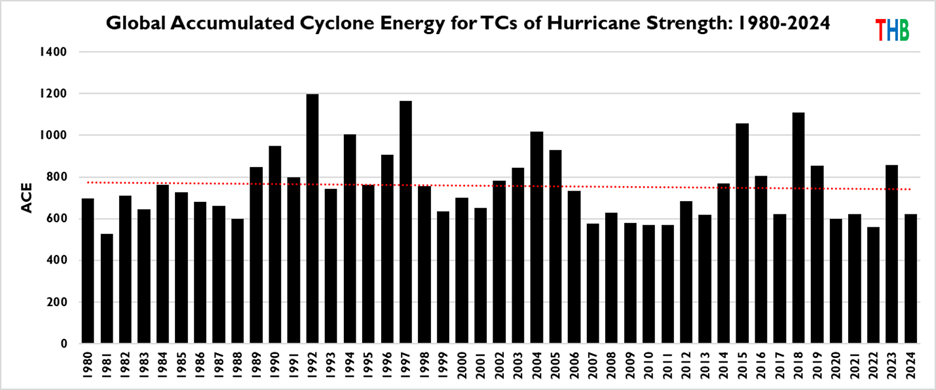
Fifth, empirical analysis posted this week by American Enterprise Institute scholar Roger Pielke, Jr. confirms the assessment of AR6 and the DOE authors that robust detection of a trend towards stronger hurricanes continues to elude scientists.

The chart below tracks annual changes in accumulated cyclone energy (ACE), a metric integrating hurricane intensity and duration, for global tropical cyclones of hurricane strength during 1980-2024. There is no trend.

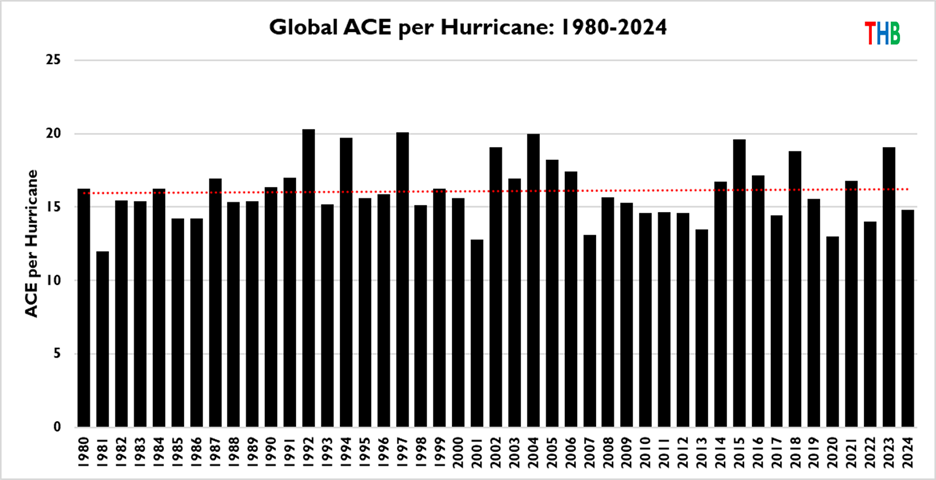
The next chart shows the global ACE per hurricane. There is also no trend.

Pielke, Jr. comments:

That lack of trend challenges a popular hypothesis—specifically, that changes in climate will result in fewer storms, but a greater proportion of them will be of higher intensities. As a matter of simple math, both fewer storms (the denominator in ACE/hurricane) and greater per-storm intensities (the numerator) should result in an increase in ACE per hurricane. While such a trend might emerge in the data in the future, to this point it has not.

The data depicted in the charts above should lower the already-low confidence in reported trends toward stronger hurricanes. Since the topic at hand is climate change, it goes without saying that a trend towards stronger storms could emerge in the future. To claim it is misleading not to belabor the obvious is itself misleading. It is also misleading to treat the absence of a trend towards stronger hurricanes, despite four decades of global warming, as a datum of no relevance to an Endangerment Finding.

What is even more misleading, though, is the Endangerment Finding’s reliance on overheated climate models, inflated emission scenarios, and lame adaptation assumptions — a recipe designed to exaggerate the physical effects of climate change and the socio-economic harmfulness of such effects. For further discussion of those topics, see part one and part two of “The Endangerment Finding’s disqualifying systemic biases.”"

Economic Freedom of North America 2025

By Dean Stansel, José Torra, Matthew D. Mitchell and Ángel Carrión-Tavárez. From The Fraser Institute.

  • The indices in the Economic Freedom of North America 2025 measure the degree to which governments in North America permit their citizens to make their own economic choices.
  • They include data from the 10 Canadian provinces, 50 US states, 32 Mexican states, and the US territory of Puerto Rico.
  • In the all-government index—which takes account of federal as well as state/provincial policies—the most economically free jurisdictions in North America are New Hampshire, South Dakota, and Idaho.
  • The lowest-ranking jurisdictions are all Mexican states. In last place is Ciudad de México. Above that are Colima and Campeche.
  • Alberta is the highest-ranking Canadian province, tied for 30th place with West Virginia. The next-highest Canadian province is British Columbia, tied with Rhode Island for 47th.
  • Incomes in the most economically free 25 percent of North American jurisdictions were 19 times higher than in the least-free.
  • From 2014 to 2023 the population of the freest US states grew nearly 18 times faster and statewide personal income grew nine times faster than in the least-free states.

Friday, December 5, 2025

Housing First is an Evidence-Based Failure

By Christopher J. Calton.

False Dawn by Cato’s George Selgin Ranked Among “10 Best Books of 2025” by The Wall Street Journal

By Michael Chapman of Cato.

"False Dawn: The New Deal and the Promise of Recovery, 1933–1947, by former Cato Senior Fellow George Selgin, was ranked among the “10 Best Books of 2025” by The Wall Street Journal this week. Selgin, also the director emeritus of the Center for Monetary and Financial Alternatives at the Cato Institute and professor emeritus of economics at the University of Georgia, retired this year.

The ten best books of fiction and nonfiction from 2025 were selected by the Journal’s book editors. For False Dawn, the Journal wrote

“The New Deal, George Selgin suggests, did not work the way most historians claim. This economist’s eye-opening analysis shows that the increased government centralization of the 1930s rarely resulted in on-the-ground stimulus or sustained growth. The war effort did eventually put the economy back on its feet, but equally important was President Roosevelt’s choice, in a time of crisis, to finally work with, rather than vilify, America’s businesses.”

In a June 15 review of the book, Judge Glock wrote in the Journal, “In dispassionate, careful, and finally devastating detail, False Dawn shows that, with a few exceptions, FDR’s experiments did not work…. Using decades of economic research, False Dawn should long remain the definitive word on the New Deal’s effectiveness.”

The University of Chicago Press, which published the book, notes that Selgin “draws on both contemporary sources and numerous studies by economic historians to show that” FDR’s actions raised hopes of a quick recovery from the Great Depression, but “subsequent New Deal policies proved so counterproductive that over seventeen percent of American workers—more than the peak unemployment rate during the COVID-19 crisis—were still either unemployed or on work relief six years later.”

Should America experience another severe downturn, like the Great Depression, policymakers and experts will “cast about for ways out,” says Selgin, and no doubt look to some of FDR’s policies. They would be wise, however, “to treat most of the New Deal episode as a warning about steps best avoided and to look elsewhere for better ones,” says the author.

Read an excerpt of False Dawn here

Buy First Dawn here

“Selgin mines a mountain of scholarship to prove this: New Deal measures failed to achieve, and often impeded, recovery from the Depression.” ― The Washington Post

“Norman Thomas, six-time presidential candidate of the American Socialist Party and for decades the second most popular speaker in America behind whoever was president, used to complain that the Democrats and FDR had stolen the Socialist Party Platform of 1928. Thomas was right. Read Selgin’s new book and learn why that was a false dawn for the US economy.” — Vernon Smith, Chapman University, winner of the Nobel Prize for Economics

False Dawn is an extraordinary achievement. Economists, historians, and others have been researching the New Deal’s recovery programs and policies since the 1930s, but no one has ever done so as comprehensively and astutely as Selgin. False Dawn will be required reading for all who seek to understand how the New Deal affected the course of the Great Depression.” Robert Higgs | author of Depression, War, and Cold War"


Thursday, December 4, 2025

Congressional leadership is corrupt

From Tyler Cowen.

"Using transaction-level data on US congressional stock trades, we find that lawmakers who later ascend to leadership positions perform similarly to matched peers beforehand but outperform them by 47 percentage points annually after ascension. Leaders’ superior performance arises through two mechanisms. The political influence channel is reflected in higher returns when their party controls the chamber, sales of stocks preceding regulatory actions, and purchase of stocks whose firms receiving more government contracts and favorable party support on bills. The corporate access channel is reflected in stock trades that predict subsequent corporate news and greater returns on donor-owned or home-state firms.

That is from a new NBER working paper by Shang-Jin Wei and Yifan Zhou.  Of course Alex T. has been on this issue for a long time now."

The Truth About Those ‘High Minimum Wage’ Countries

Headline wages in Finland and Australia exempt millions of workers, and the loopholes tell us a lot about labor market realities

By David Hebert of AIER.

"When debating raising minimum wages, proponents will often point to Australia and Finland as examples that contradict the warnings from (typically American) economists. On the surface, this seems like a fair point. After all, from our American perspective, things in Australia seem fine (other than the fact that even the trees are trying to kill you) and Finland has been romanticized as a triumph of progressive politics “done right.”  But before minimum wage proponents declare victory, we should read the fine print.

Looking beyond the simple story of “higher minimum wages” and into the underlying structures of these countries’ respective economies reveals a web of exemptions, alternative employment structures, and differing educational emphases. Mandated high minimum wages with built-in escape hatches and exemptions large enough to drive a truck through are not really “minimums.”

The Land of Oz

Australia loves to mention that they have one of the world’s highest minimum wages, at $24.95 per hour (the equivalent of about $16.16 in USD). This headline-grabbing figure only tells part of the story, however, as there are exemptions to this depending on an employee’s age, industry, and myriad other conditions.  Helpfully, the Australian government has put together a Pay and Conditions Tool to help figure this all out.  As a rough approximation, a person who is 17 years old can roughly count on a minimum wage equal to about 60 percent of the “adult” pay rate, giving them an effective minimum wage of $14.42 ($9.34 USD) and $17.04 on their 18th birthday ($11.04 USD).  

But what about workers with a disability?  The Department of Social Services will determine how much a disabled worker will be paid based on the nature of their disability. Under the Supported Wage System, “a special workplace arrangement can be made for employers to pay wages to a person with disability based on how productive they are in their job. Under [this system] an employee’s work capacity is assessed to find out their rate of pay… For example, someone with an assessed work capacity of 70 percent is entitled to 70 percent of the relevant pay rate in their award or registered agreement.” 

In other words, the Australian minimum wage that Americans have heard so much about only applies to people without disabilities who are at least 21 years old, and even then, only sometimes. But this still doesn’t scratch the surface of the employment situation in Australia. Most of the jobs where the minimum wage actually applies are in industries such as restaurant and retail, where the work is so highly standardized that there are no real, appreciable productivity gains year over year.  Are we really to believe that a 21-year-old waitress carries plates or restocks inventory 44 percent better than her 18-year-old counterpart? 

As a result of the age-based pay scale, Australian workers in these industries are laid off at a disproportionately higher rate as they approach their 21st birthday, though effects can be seen at every birthday up until the worker turns 21.

Employers defend this system with a simple story: young workers lack experience and are therefore less productive because they’re still learning. They need training, which costs money, and are consequently paid less to “pay for” the training they receive on the job.

It’s a nice story and one that comports with much of what Americans might experience, too. The truth is that many young workers in Australia have already completed pre-employment training, earning certificates and such, before they even start work. And in the sectors where the junior minimum wages are most common, the work is highly standardized, such that there isn’t much productivity gained between 18 and 21.

That said, there are legitimate programs where younger workers earn lower wages than their older counterparts.  Australia’s apprenticeship program is incredibly robust. A first-year electrician earns around 60 percent of the wages of a qualified tradesperson because they are genuinely learning and getting demonstrably better each year thanks to the supervision and training they receive from their more senior coworkers. Wages in these settings increase not because of age, but because competence grows, and by the time the worker has completed their training, they earn full rates and have a valuable qualification they can take with them elsewhere, not to mention an all-important line on their resume attesting to their productivity.

Finnish Wage Floors

Unlike America and Australia, Finland actually does not have a formal, statutory minimum wage.  Instead, they use collective bargaining agreements, which cover somewhere around 90 percent of workers. Like Australia, however, they also have exemptions for workers who are “training” or in “apprentice programs.” The difference is that in Finland, the training programs last for a specific amount of time irrespective of the employee’s birthday. They’re based on skill, not age.

Finland also boasts a remarkable vocational and education training program (VET) that “provides students with knowledge and skills necessary in further studies and promotes employment.”  According to their own figures, around half of the students who complete their basic education in Finland matriculate on to VET rather than “general upper secondary education.” In other words, at around the age of 16, roughly half of the students decide to go into vocational training rather than continue on to what Americans commonly refer to as “college.”

While Finnish students are enrolled in the VET, they can work for pay at the agreed-upon rates covered by the collective bargaining agreement through formal apprenticeship programs.  According to the European Centre for the Development of Vocational Training, about 26 percent of VET students are enrolled in such a program. The remaining 74 percent, however, are either in the classroom or are engaged in “training agreements,” some of which allow the student to be unpaid while being formally employed. Others are informal, handshake agreements “under the table” whereby the student is not an employee and thus receives no wages.

Thus, what Finland has is a high, collectively agreed-upon wage floor. But they do this by pushing most of the vocational training into the (unpaid) education system. The high wage floor exists, but workers don’t get to stand on it until they’ve completed their training, formal and sanctioned or otherwise.

Reforms in America

The next time someone tells you about Finland’s wonderful labor market or Australia’s high minimum wage (or any other country, for that matter), ask about the fine print. When you look at these issues more closely, the surface-level claims of minimum wage proponents simply do not hold water.

Still, as the US continues to wrestle with reforms to our education system, we can learn from these countries’ experiences. Finland in particular, with its curricular focus on career preparation instead of rote memorization of obscure knowledge (when was the last time any of you, dear readers, used your knowledge of trigonometry?), provides an important example where lessons for reform can be learned.  

We should carefully guard against the headline-grabbing claim that Australia and Finland have high minimum wages. We should especially reject the idea that this somehow proves that raising the minimum wage does not always lead to trade-offs."